
Kebab choices, explained
Seekh kebab vs reshmi kebab: what is the difference?
Both are minced-meat skewers in our joint menu entry. Broader traditions distinguish seekh by meat shaped around a skewer and also include chicken versions of reshmi kebab, but our current description does not publish every recipe-level difference.
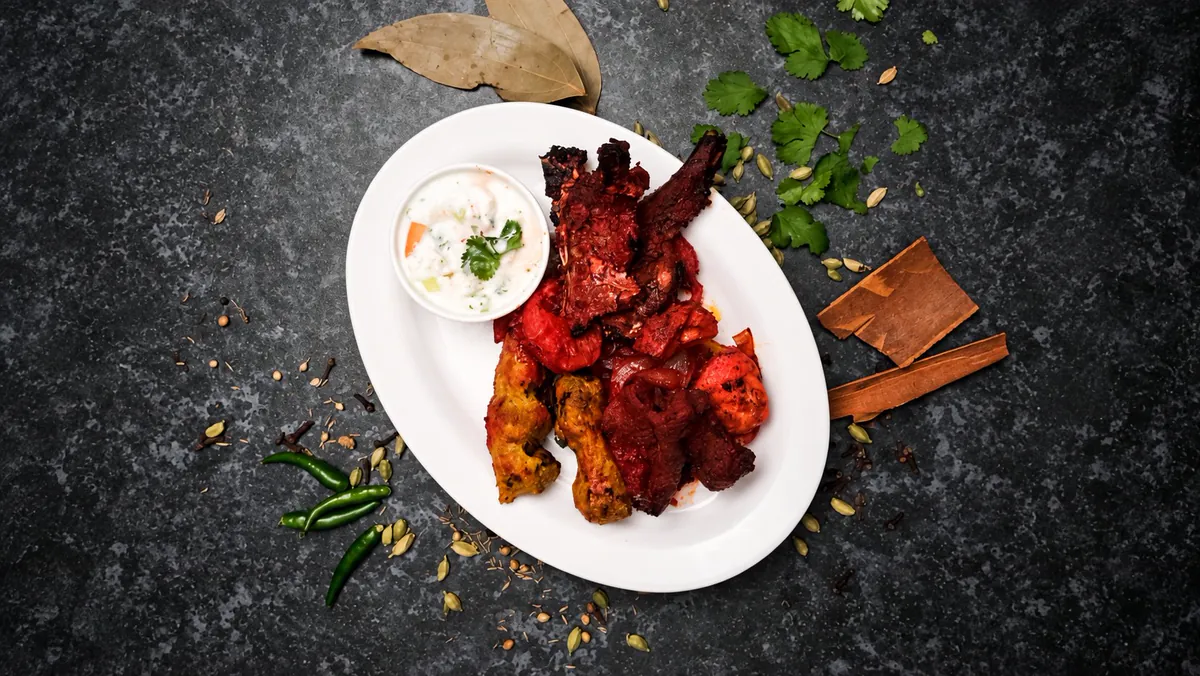
Shared descriptionMinced lamb or chicken with herbs
CookingCooked on skewers
Printed markerGluten-free
The Great Kathmandu groups Seekh Kebab / Reshmi Kebab in one entry: minced lamb or chicken seasoned with eastern herbs and cooked on skewers, £8.50 half or £13.50 full, marked gluten-free. The short description does not explicitly map one meat to each name or publish separate marinades, so ask the team when that distinction affects your choice.
- Menu entry
- Seekh Kebab / Reshmi Kebab
- Published meats
- Minced lamb or chicken
- Seasoning
- Eastern herbs
- Cooking format
- Skewers
- Price
- £8.50 half / £13.50 full
- Dietary marker
- Gluten-free
What is a seekh kebab?
Oxford’s kebab definition describes small pieces of meat and vegetables cooked on a wooden or metal stick, while seekh kebab has a more specific minced-meat form. India’s official tourism site describes a Bhopal seekh kebab as minced meat wrapped around a skewer and roasted over an open flame.
That broad context fits the skewer and mince language on our menu, but it does not reveal our exact spice blend or cooking sequence. For the role of high heat and charcoal in nearby dishes, read our tandoor cooking guide.
The shared menu line tells you what is certain; the kitchen can explain today’s precise choice.
What is a reshmi kebab?
Collins Hindi–English Dictionary translates reshmi as “silky,” meaning smooth and soft. That helps explain the name’s common association with tenderness, but a word meaning is not a recipe and our menu does not make a specific texture promise.
Our joint entry lists minced lamb or chicken without explicitly assigning one meat to Reshmi Kebab. It would therefore be overconfident to state a mapping as a guaranteed current service detail. Ask when ordering if you want one named kebab, a particular meat or information about marinade ingredients.
Where else do these kebabs appear on the menu?
Seekh kebab appears in Tandoori Mixed alongside tandoori chicken, chicken tikka and boti kebab. It is also listed in Set Meal A, Set Meal B, the Great Kathmandu Special Banquet and Nepalese Mixed Masala. Those combinations make it one of the menu’s recurring grilled elements.
Reshmi kebab appears in the Kathmandu Mixed Starter alongside king prawn, tandoori chop and fish tikka. The separate mixed-dish descriptions do not repeat portions, dietary markers or the complete joint-entry recipe, so details should not be transferred automatically.
For another skewer format that uses pieces rather than published minced meat, compare our shashlik guide. For loose mince and meatballs, read the keema guide and kofta guide.
How should you choose between them?
If you simply want a skewered minced-meat starter, the joint entry gives you half or full portions. If your preference is specifically lamb, chicken, Seekh or Reshmi, ask the team to confirm how today’s choice is served rather than relying on an assumed one-to-one mapping.
For a table seeking variety, a kebab can be paired with a vegetable starter and a sauce-led main. Tandoori Mixed gives a broader mixed-starter selection, while Kathmandu Mixed Starter introduces seafood. Our ordering guide helps prevent too many similar starters.
Are the kebabs gluten-free?
The combined Seekh Kebab / Reshmi Kebab entry is marked gluten-free. It has no mild, hot, vegetarian, vegan or nuts marker. An absent label does not prove an allergen is absent or establish a heat level.
Mixed starters and set meals have their own ingredient context and do not necessarily inherit this single-item marker. For coeliac disease, allergies or intolerances, speak to the team. The Food Standards Agency stresses current allergen information and cross-contact communication.
Common questions
Is seekh kebab always lamb?
Seekh can use different minced meats in wider cooking. Our joint entry names minced lamb or chicken but does not explicitly map each meat to one kebab name.
Is reshmi kebab always chicken?
Chicken appears in an official Indian tourism description, but our menu groups the choices. Confirm the current serving with the team.
Are these kebabs hot?
No heat rating is printed, so a level should not be inferred from the name.
Can I order a half portion?
Yes. The entry offers £8.50 half and £13.50 full portions.
Source notes
Reviewed 19 September 2026. Where this guide mentions our restaurant, details are checked against the current dine-in menu. Wider cultural, historical and ingredient claims are checked against the cited sources below. How we research and correct our guides.
- The Great Kathmandu dine-in menu, consulted 18 September 2026, for the joint description, portions, prices, marker and appearances in mixed dishes.
- Oxford Advanced Learner’s Dictionary: “kebab”, for the broad skewer definition.
- Incredible India: Bhopal street foods, for a documented seekh-kebab preparation.
- Incredible India: Kolkata food guide, for a documented chicken reshmi kebab.
- Collins Hindi–English Dictionary: “reshmi”, for the “silky,” smooth and soft meaning.
- Food Standards Agency: allergen guidance, for UK allergy-information context.
Share a skewered starter.
Book our family-run West Didsbury restaurant or order delivery direct.