
Your first visit, made simple
How to order at a Nepalese restaurant
For two people, a useful starting point is one or two starters, two contrasting mains or a main plus vegetables, and rice or bread. The best order is varied—not a test of how many unfamiliar names you know.
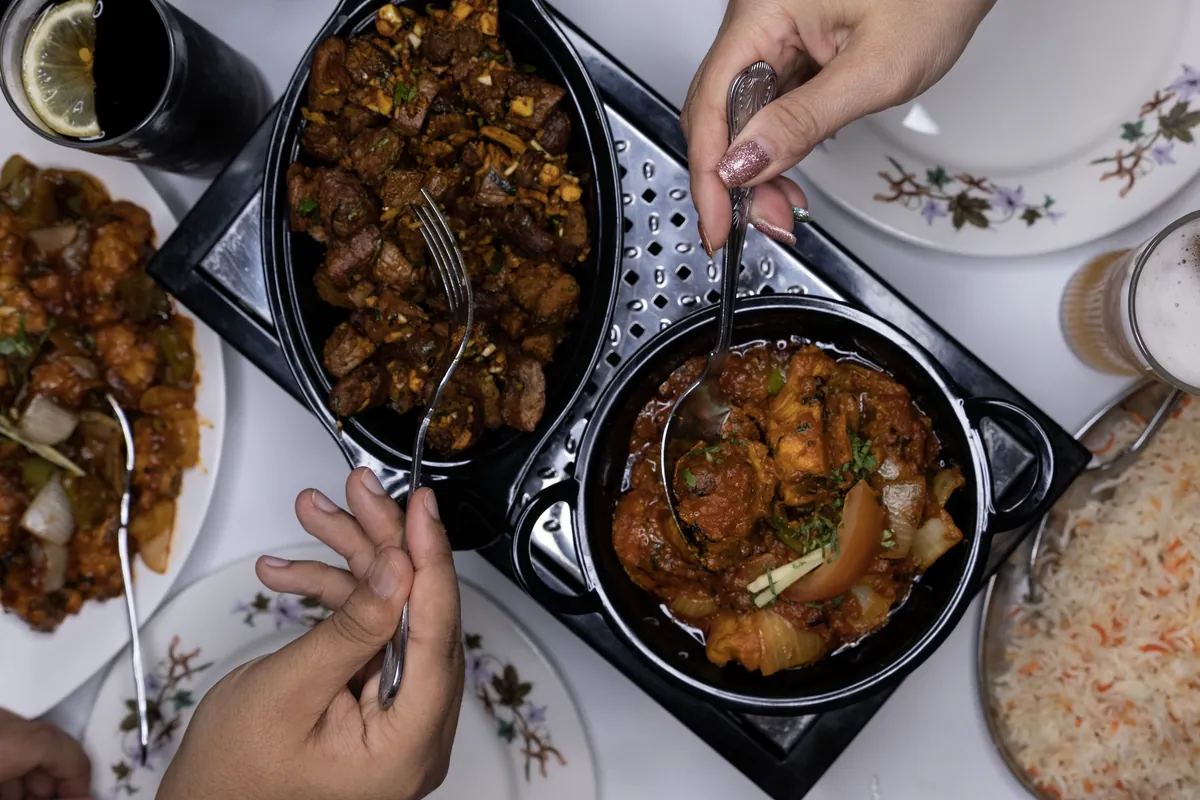
Start with contrastDifferent formats, flavours and textures
Share if you likeBuild a table rather than one fixed formula
Ask usHeat and allergen questions are welcome
A simple order for two is one shared starter, two contrasting dishes, and accompaniments such as vegetables, dal, rice or bread. This is practical guidance, not a traditional rule. Our family-run West Didsbury menu brings Nepalese and Indian dishes together.
- 1. Starter
- Try dumplings, a dry Nepalese dish, pakoda or tandoor cooking
- 2. Main dishes
- Choose contrasting sauce, heat and main ingredient
- 3. Vegetables or dal
- Add spinach, lentils, chickpeas, aubergine or potatoes
- 4. Rice or bread
- Pick the accompaniment that suits your table
- Shortcut
- Four set-menu routes are listed per person
- Always
- Tell the team about allergies before ordering
Step one: choose a starter with a different texture
Mo:Mo are six Nepalese dumplings with lamb, chicken or vegan filling and tomato chutney. They may take more than 20 minutes. Kathmandu Choila is a dry Nepalese dish with chicken or lamb, herbs and spices. Neither name alone tells you its allergens or heat.
Other choices include tandoor-cooked meat, fish and paneer; fried pakoda; samosas; kebabs; and hot chilli starters. If both mains will be rich sauces, a dry starter can add contrast.
A memorable order has rhythm: something to begin, contrasting dishes to share, and rice or bread that belongs at the table.
Step two: choose mains by character, not just protein
Makhan Chara is chicken tikka in a mild tomato-and-cream sauce. Kathmandu Bhotowan is a medium-hot dry dish. Khorsani is hot; Vindaloo is very hot. Handi has a smooth onion-and-tomato sauce, while Karahi lists onion, capsicum, tomato, garlic and ginger.
Two different sauces, textures or heat levels give a shared meal range. Try a mild creamy dish beside a dry medium-hot one, or vegetables beside meat or seafood. Menu labels are more reliable than assumptions about familiar names. Use our heat guide before selecting.
Step three: add vegetables, lentils, rice or bread
Dal Tarka is lentils with ginger and garlic and comes as a side or main. Chickpeas, aubergine, spinach and potato dishes can broaden the table or provide a vegetarian main. A vegetable or lentil dish can be the centre of the meal, not merely an extra.
Choose from boiled basmati, Pillau Rice, vegetable or mushroom rice, and breads. Nan is leavened; Roti / Chapati is unleavened; Paratta is cooked with butter. Our bread guide compares them. Quantity depends on appetite.
Can a set meal do the choosing for you?
Yes. Set Meal A combines tandoori chicken, seekh kebab, bhuna gosht, prawn masala, pillau rice and nan. Set Meal B adds a larger mix that includes tandoori chicken, seekh kebab, chicken tikka, rogan josh, makhan chara, mixed vegetables, pillau rice and nan; it is marked as containing nuts.
The Vegetarian Set Meal includes onion pakoda, paneer pakoda, mixed vegetables, muttar paneer, dal, pillau rice and nan. The Great Kathmandu Special Banquet includes meat, seafood, vegetables, rice, special nan and prosecco; it requires a minimum of two orders and is dine-in only. All four prices are listed per person on the current menu.
Which dishes need planning ahead?
Murgi Masala requires 24 hours' notice. It is a whole tandoor-cooked chicken with a special biryani for two to three people and is marked as containing nuts. Contact the restaurant; a booking alone does not place the food order.
Mo:Mo may take more than 20 minutes. The Special Banquet requires at least two orders and is dine-in only.
How should you order with dietary requirements?
Read every printed marker, then speak to the team. “Vegetarian,” “vegan option,” “gluten free” and “contains nuts” answer different questions. Mo:Mo and Namche Chilli offer vegan options, but you must specify that option. Vegetarian paneer contains milk. A gluten-free marker does not automatically answer questions about other allergens or kitchen cross-contact.
The Food Standards Agency advises customers to communicate allergy requirements clearly. Tell us before ordering, ask about the complete dish, and check again if choices change. Online guides are helpful preparation but cannot replace current restaurant information for an allergy.
Common first-visit questions
Is Nepalese food the same as Indian food?
No. Nepal has distinct food cultures, while geography and history also create connections across South Asia. Neither cuisine should be forced into one definition.
Do I have to share?
No. Sharing can make comparison easier, but individual courses are entirely valid. Order for your appetite and preferences.
Are all Nepalese dishes hot?
No. Heat varies, and Nepalese identity is not a chilli rating. Follow the menu's labels and ask about unmarked dishes.
Where should a first-time diner begin?
Browse the current dine-in menu, note one starter and two contrasting mains that interest you, then ask the team to help complete the table.
Source notes
- The Great Kathmandu dine-in menu, consulted 18 September 2026, for every dish, timing note, set-meal condition and dietary marker specific to the restaurant.
- Nepal Tourism Board: Culture, for the broader context that Nepal contains many cultural communities and traditions.
- Food Standards Agency: allergen guidance for food businesses, for the importance of clear, current allergen communication.
Make your first visit to West Didsbury.
Book our family-run restaurant, established in 1986, or order delivery directly from us.