
Rice and grains, explained
What is basmati rice?
Basmati is a slender, aromatic long-grain rice. On our current menu it is named in two biryanis, lightly flavoured pillau rice and plain boiled rice—four different ways to use the same grain.
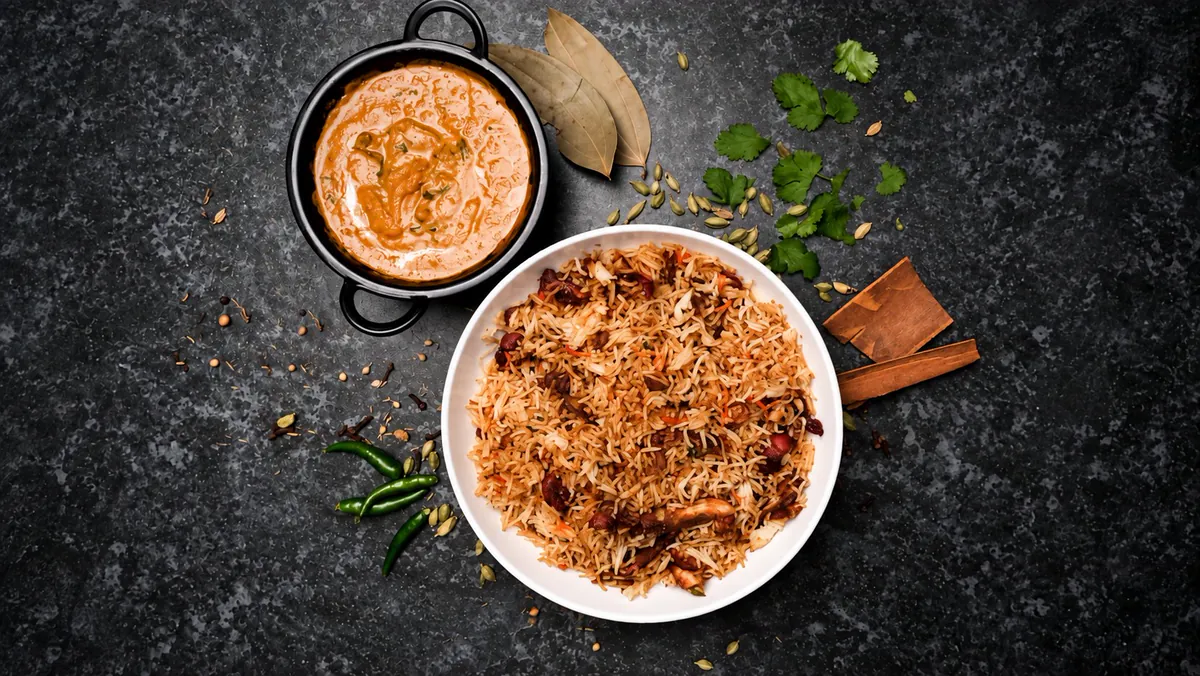
Long-grain riceSlender and aromatic
Four menu usesTwo biryanis, pillau and boiled
Two rice sidesMarked vegetarian and gluten-free
Basmati is an aromatic variety of long-grain rice associated with South Asian cooking. “Basmati” identifies the rice, while “pillau” and “biryani” describe prepared rice dishes. At The Great Kathmandu, Lamb and Chicken Pillau Biryani explicitly use basmati, while Pillau Rice and Boiled Rice are also described as basmati.
- Grain
- Long, slender and fragrant
- Plant
- A cultivated form of Oryza sativa
- Biryanis
- Lamb and chicken use basmati
- Rice sides
- Pillau and plain boiled basmati
- Printed markers
- Both sides are vegetarian and gluten-free
- House method
- Not published on the menu
What makes rice “basmati”?
UK government commodity guidance describes basmati as long-grain, aromatic, fragrant, slender and non-glutinous, and says it lengthens as it cooks. India’s Agricultural and Processed Food Products Export Development Authority (APEDA) likewise emphasises extra-long slender grains, aroma and marked lengthwise elongation. “Non-glutinous” describes the grain's starch behaviour; it is not an allergy statement about a finished restaurant dish.
Botanically, rice is Oryza sativa, a grass cultivated across much of the world. Kew identifies rice as a foundational food crop and distinguishes broad long-grain and short-grain cultivar groups. Basmati is a more specific culinary and trade name within that enormous rice family, not a cooking style by itself.
APEDA notes that growing region, harvesting, processing and ageing all contribute to characteristic basmati quality. Cooking method also affects a finished bowl, but our menu does not publish its kitchen method, so this guide explains the category without presenting a supposed house recipe.
Basmati names the grain; biryani, pillau and boiled rice name different preparations.
Is basmati the same as pillau or biryani?
No. Basmati is rice. Pillau—also written pilau or pulao—is a seasoned rice preparation, while biryani is a more substantial rice-centred dish. Either can be made with basmati, but the words are not interchangeable. Our biryani and pilau guide compares the menu roles in more detail.
The distinction matters when ordering. A side of Pillau Rice supports another main. Lamb or Chicken Pillau Biryani is already a main and arrives with vegetable curry. That difference in format tells you more about the meal than the shared grain does. The Kathmandu Special Pillau Biryani also contains lamb, chicken and prawn and is topped with boiled egg, cashew nuts and brown onions; its description says pillau rice but does not separately use the word basmati, so we do not add it.
Which rice should you order?
Choose boiled basmati when you want a plain accompaniment that leaves the focus on a richly sauced main. Pillau Rice adds a “hint of eastern flavour” according to the menu and can bring a little more character to a shared spread. A biryani is the rice-led choice: meat and mildly spiced basmati are combined and accompanied by vegetable curry.
For two people sharing several dishes, one rice side can be a sensible starting point, with bread added if wanted. Our first-time ordering guide offers a flexible way to balance starters, mains, vegetables, rice and bread. If you are deciding between accompaniments, the naan, roti and paratha guide explains the bread side of that choice.
Prices and portions can change, and appetite varies. Treat this as planning help rather than a rule; the team can suggest an order for your table.
Is basmati rice gluten-free or vegan?
Plain rice does not itself contain gluten, but restaurant suitability depends on the complete dish and kitchen handling. On our menu, Pillau Rice and Boiled Rice are both specifically marked vegetarian and gluten-free. Neither is marked vegan, so this page does not claim that status. The biryanis do not carry gluten-free or vegetarian markers.
A missing marker is not proof that a dish is unsuitable; it simply means we should not promise suitability from the public menu. Tell the team about coeliac disease, allergies or other requirements before ordering. The Food Standards Agency recommends written allergen information supported by a conversation, especially where cross-contact matters. See our vegetarian and vegan guide for explicitly marked choices.
Common questions about basmati rice
Does basmati always mean pillau rice?
No. Basmati is the grain. It can be boiled plainly or used in preparations such as pillau and biryani.
Is basmati sticky rice?
UK government guidance classifies basmati as non-glutinous and says it lengthens when cooked. Technique still affects the finished texture.
Is your biryani hot?
The Lamb and Chicken Pillau Biryanis are described as using mild oriental spices, but they have no separate printed heat marker. Ask if chilli sensitivity matters.
Can I see current prices?
Yes. Check the live menu; prices here were checked on 18 September 2026.
Source notes
Reviewed 19 September 2026. Where this guide mentions our restaurant, details are checked against the current dine-in menu. Wider cultural, historical and ingredient claims are checked against the cited sources below. How we research and correct our guides.
- The Great Kathmandu dine-in menu, consulted 18 September 2026, for restaurant-specific rice names, descriptions, prices and dietary markers.
- Cambridge Dictionary: basmati rice, used only for the broad English-language term.
- UK Government: classifying rice, for trade characteristics and listed basmati varieties.
- APEDA: Basmati Rice, for official Indian product characteristics and the roles of geography, processing and ageing.
- Kew Science, Plants of the World Online: Oryza sativa, for botanical and cultivation context.
- Food Standards Agency: allergen information for non-prepacked food, for UK allergy-information context.
Try basmati in West Didsbury.
Book our family-run restaurant, established in 1986, or order delivery directly from us.