
Flavour at the side of the plate
What is Nepalese achar?
Achar is a broad family of punchy accompaniments rather than one standard pickle. It can be fresh, cooked or fermented; smooth or textured; gently sour or fiercely hot—and a small serving can change the balance of an entire meal.
Not one recipeFresh, cooked and fermented forms
Role on the plateSourness, heat, aroma and contrast
On our menuTomato chutney, achar and lime pickle
Nepalese achar is an intensely flavoured accompaniment served in a relatively small amount alongside a meal or snack. English menus may call it pickle, chutney, sauce or dip, but no single translation covers every preparation. Achar may use vegetables, fruit, tomato, sesame, herbs or spices and may be freshly mixed, cooked, preserved or fermented.
- What it is
- A varied category of condiments and accompaniments
- Possible forms
- Fresh, cooked, preserved or fermented
- Possible flavours
- Sour, hot, salty, aromatic, nutty or combinations of these
- Meal context
- Often served with dal, rice and vegetable preparations
- Our momo
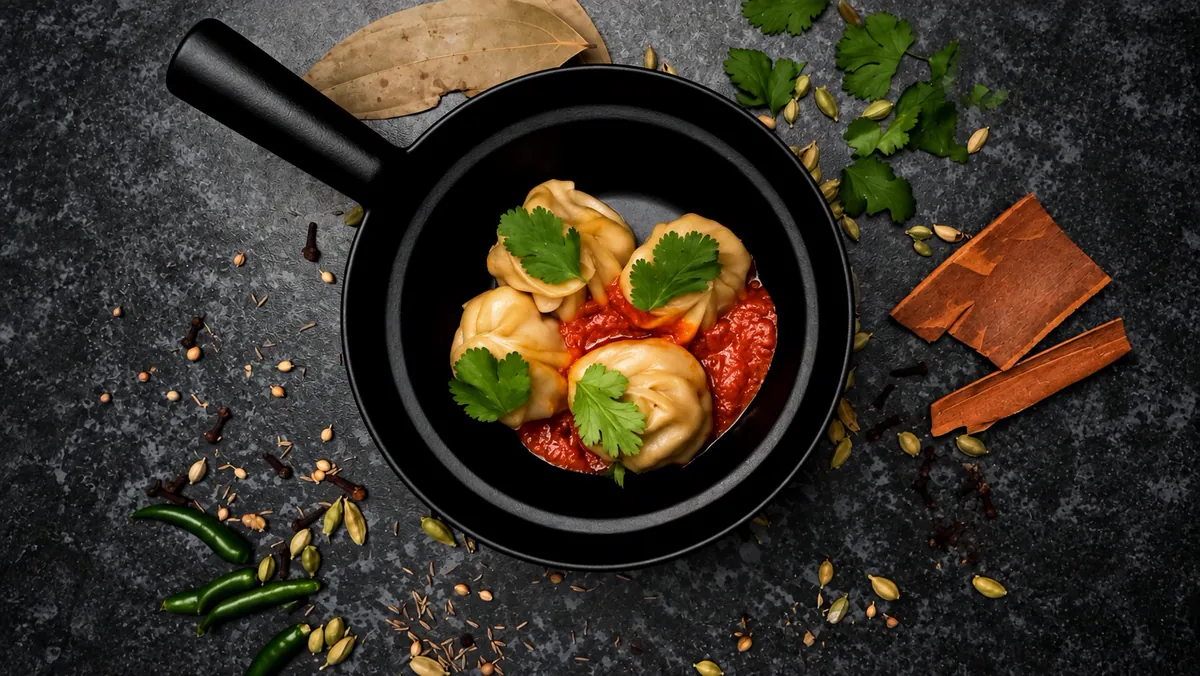
- Served with tomato chutney
- Important caution
- Names alone do not reveal every ingredient or allergen
Why is achar difficult to translate with one English word?
Nepal Tourism Board describes achar as the pickle that commonly accompanies dal, bhat and tarkari. "Pickle" is useful, but British English often suggests vegetables preserved in vinegar or brine. Nepalese achar can be much broader than that image.
Some preparations are pounded into a dip. Others retain pieces of vegetable or fruit. A tomato achar may resemble what an English menu calls chutney, while a fermented radish or bamboo preparation may sit closer to pickle. The boundary between achar, chatani, sauce and dip changes with language, texture and context.
For diners, the practical question is not which English label wins. It is what the accompaniment contains, how it was prepared and what flavour it brings to the food beside it.
Achar is best understood by its role: a concentrated accent that wakes up the rest of the plate.
Is Nepalese achar always fermented?
No. Fermentation is important to many Nepalese preserved foods, but it does not define every achar. A peer-reviewed study of culturally diverse fermented foods documents Nepalese achars prepared from vegetables with spices, oil and salt, alongside other ferments such as gundruk, sinki and taama. That evidence shows that fermented achar exists—not that every fresh tomato dip has undergone fermentation.
A freshly combined or cooked sauce can be made for immediate use. Other ingredients are preserved to develop acidity and last beyond a harvest. Our guide to Nepalese fermented foods looks more closely at gundruk, sinki and tama without treating fermentation as a shortcut to health claims.
Which ingredients can shape an achar?
The Nepal Tourism Board heritage-cuisine book records several contrasting sauces. Timmure golbhenda uses tomato, chilli, garlic, mustard oil and timmur. Lasune golbhenda centres tomato and garlic. Dhaniya sada uses coriander, while tilko chhop begins with sesame. These recipes demonstrate range; they are not a definitive list.
Spices can bring more than heat. Timmur adds a distinctive aromatic quality, fenugreek may be tempered in oil, and sesame or peanut can contribute body. Our guide to timmur and jimbu separates two Nepalese ingredients that are often flattened into the vague phrase "Himalayan spice."
The reference sauces above are cultural examples and are not advertised as separate dishes on The Great Kathmandu's current menu. We do not use their ingredient lists to describe our own tomato chutney.
How does achar fit into a Nepalese meal?
Achar supplies contrast. A sour or hot spoonful can interrupt the softness of rice and dal; a textured sesame accompaniment can sit against a steamed dumpling; a tomato-based dip can add moisture and acidity to a snack. It is usually a supporting element, yet it may be the flavour a diner remembers most clearly.
That role appears in the broader pattern of Nepalese food culture, where dal, rice, vegetables and achar can share one meal. It also appears in specific pairings. The NTB heritage recipe serves momo with timmur-tomato or peanut-coriander sauce, while other dishes have their own suitable accompaniments.
Common questions about Nepalese achar
Is achar the same as chutney?
The terms overlap in English-language menus, but they are not exact synonyms in every context. Preparation and texture matter more than a rigid translation.
Is achar always very hot?
No. Some versions contain plenty of chilli; others emphasise sourness, tomato, herbs, seeds or fruit. Ask about the particular achar rather than assuming.
Is all achar vegan or gluten-free?
No universal dietary claim is safe for such a broad category. Ingredients and kitchen handling vary, so check the specific item with the restaurant.
Can I order the momo tomato chutney separately?
The current menu states that it accompanies Mo:Mo but does not list it as a separate item. Ask the team about current availability.
Source notes
- Nepal Tourism Board: Culture of Nepal, for achar's place alongside dal, bhat and tarkari.
- Nepal Tourism Board: Globalizing Nepalese Heritage Cuisine Recipe Book, printed pages 84–93, for documented tomato, coriander and sesame sauces.
- BMC Microbiology: Ecological factors that drive microbial communities in culturally diverse fermented foods, for the distinction between several Nepalese plant ferments.
- The Great Kathmandu dine-in menu, consulted 18 September 2026, for tomato chutney, Chaat Phat, mango chutney and lime pickle claims.
Build a table full of contrast.
Join our family-run restaurant in West Didsbury, serving Manchester since 1986.